


Collection agencies have a bad reputation, and unfortunately, it’s a bit of an earned one. I say unfortunately because there are some fantastic commercial collection agencies out there who act very professionally and provide their clients with a great service. A few bad apples have tainted the public’s perception of the ARM (accounts receivable management) industry as a whole, and this causes a little apprehension when a company is trying to decide whether to enlist the help of a collection agency.
If you do your homework and partner with a good agency, a professional collector can do wonders for your business. When it comes to mechanics liens, enlisting some collections help when you run into a payment dead end can be the difference between getting the lien claim paid and not.

What A Collection Agency Can Do That You Can’t
Every business is a niche business in some sense of the term. If you’re a painter, you know painting. When a general contractor proposes to self-perform the work because it’s “easy,” or when a homeowner figures they will just do the painting themselves, it makes your blood boil. You know you can do a better job and that your service has value. You live it everyday.
Sometimes, we forget to see things in the same way when thinking about other services. Every service comes with a cost, but since the vendor you select focuses on that particular service, there is value in what they do simply because they know how to do it so well. That is the first point I want to make about why a collection agency can be great for your company.
Sure, you can make phone calls and send letters in-house, but you can’t do it the same way a collection agency will because the collection agency has irreplaceable experience in collecting accounts and has the ability to focus on providing this service to your account (your focus, remember, is on providing your particular service).
Here are some other things a collection agency can do that you can’t:
- Send letters and make phone calls as a collection agency, which alerts your debtor that you have escalated the debt;
- Be independent and distant from you – the creditor – which means a little more leverage in negotiating the debt payment;
- Report debts to credit reporting offices;
- Get Skip-Tracing reports on debtors and conduct other debtor research;
How To Collect On A Mechanics Lien
So what goes into collecting on a mechanics lien claim?
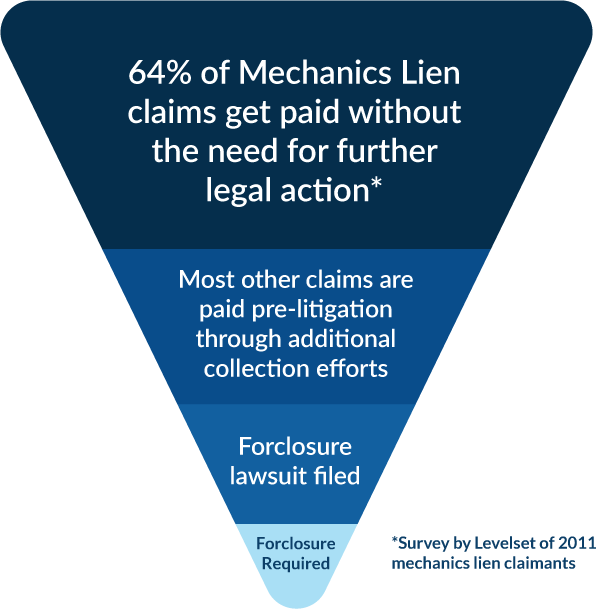 In the past, we’ve talked about how effective a mechanics lien can be by just having it filed. For example, over 64% of lien claims are paid within 3 months of filing without any additional collection or legal work.
Take a look at the funnel infographic. This also shows the 64% of mechanic lien claims that are paid immediately and without further legal work. If the debt still isn’t paid, you can take additional collection efforts that are likely to get paid as well. More claims are resolved with each additional collection action that you perform. This part of the blog post is focusing on that additional collection effort.
Consider Using A Company To Help You Collect
The beginning of this post made the case for hiring a collections agency to help you collect a debt like a mechanics lien claim, and I’ll reiterate it here. If you’re at a dead end trying to collect on your mechanics lien claim, get someone to help you collect it. This will escalate the debt in the mind of the debtors, and you can try a few new tricks to recover the debt that weren’t previously available to you.
It’s a good idea to get a debt collector who understands construction debts and mechanics lien claims specifically. Mechanics lien claims are a special breed of debts and there are a number of advantages these claims provide your company…if they are properly understood.
Get In Touch With All Of The Parties
One of the primary benefits of the mechanics lien filing is that you get a lot of parties involved, including the property owner and the prime contractor. Depending on the state law application, the lender’s interest in the property may also be effected. If you’re sitting on a mechanics lien claim, you substantially increase your chances to collect the debt if you reach out to all the parties, educate them about your debt and make sure they understand that they may be legally liable if further pursuit is required.