


The California 20-day preliminary notice is a document that contractors and suppliers must deliver to retain the right to file a mechanics lien or bond claim. California law requires preliminary notice on both private and public jobs in the state.
Although preliminary notices are important for payment rights, sending prelims is also a best practice that benefits everyone on the job. That’s because notice recipients — typically general contractors, property owners, and lenders — rely on notices to paint a picture of all of the parties that are working on the project. This makes it much easier to request, collect, and track lien waivers down the road.
The good news is that California’s preliminary notice requirements and deadlines are rather straightforward.
This comprehensive article will explain everything you need to know about California’s preliminary notices. The article will also walk you through preliminary notice best practices, common mistakes, and some frequently asked questions. Read on to learn what you need to get the 20-day notice right.
What Is a California 20-Day Preliminary Notice?

California’s preliminary notice form itself is pretty unremarkable. While it may look intimidating at first, you’ll see that it’s a very simple form once you spend some time with it.
You can get a free copy of the California preliminary notice form here. Our forms are created by construction lawyers to meet the requirements of California statute.
The California preliminary notice is important for a variety of different reasons. Most importantly to contractors and suppliers who expect payment on jobs, they must serve preliminary notices to preserve the right to file a mechanics lien or bond claim on the job.
In other words, if you don’t send a preliminary notice in California, you won’t have lien rights. This is the case on both private jobs (i.e. commercial, residential), and public jobs (i.e. state, city, municipal, government, etc.).
The California preliminary notice requirements are similar to the requirements of other states (See 50-State Preliminary Notice FAQs and Requirements). And, generally speaking, they are good-faith, collaborative documents that benefit all project participants.
Watch an overview of CA preliminary notices
Where did the term “preliminary 20-day notice” come from?
You may hear people refer to this form by a number of different names. These other names include: “California Preliminary 20-Day Notice” or the shorter “Preliminary 20-Day Notice.” Interestingly, before a 2012 change to the state’s notice laws, the process didn’t have a formal name, and the industry called it different things. A law change effective on July 1, 2012, officially changed the terminology to simply, “Preliminary Notice“. However, you’ll still find folks who refer to this document and process by a variety of labels.
Need to send a 20-Day Notice?
We’re the 20-Day Notice experts. With us it’s fast, easy, and done right. And free.

Why Send a California Preliminary Notice?
Here’s the bottom line. In California, you need to send a preliminary notice to maintain the right to file a mechanics lien on a construction project. However, this is just one of many reasons to send preliminary notices on a California project. In this section, we’ll explore why this document exists, why it’s important, and why you need to send one.
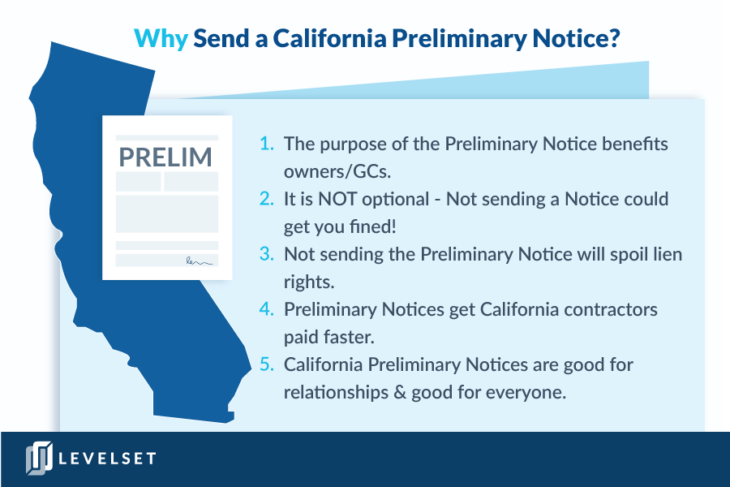
1. The Purpose of the Preliminary Notice Benefits Owners/GCs
While contractors and suppliers need to send a preliminary notice to protect their mechanics’s lien and bond claim rights, that is not the purpose of the process. Instead, this is just a consequence when they don’t follow the process.
The main purpose of preliminary notices is to share information. They let property owners & developers, construction lenders, and GCs know who is working on or providing materials to the job. This protects job participants against the risk of a “surprise lien” from some unknown contractor or supplier who didn’t get paid. Sending a notice establishes a line of communication that gives all of the parties a better opportunity to prevent any payment issues from developing into full-blown problems.
California GCs are liable for the wages & benefits of everyone on the job
In California, it’s especially important for general contractors to know everyone on their job. This is because of a law (effective January 1, 2018) that holds GCs liable for the wages & benefits of every employee that works on a job. This is true even for the employees of subcontractors and sub-subcontractors of any tier. This is a major risk for general contractors.
The purpose of the preliminary notice process in California is to facilitate a smooth payment process for everyone on the project. These documents help ensure timely, accurate payments and avoid mechanics liens and other major problems.
2. Failure to Send A Notice Could Result in a Fine
It’s common for contractors and suppliers to send preliminary notices on some projects and not others in California. This is usually done to fulfill to some “credit policy” or “notice policy,” where companies elect to send notices only when a project has a value over a certain dollar amount.
The reasoning here is sound. The costs and complications of sending a preliminary notice may not be worth it if the job value is too low, or the contractor/supplier may be willing to take the risk of non-payment for certain customers.
This might be the most important thing to remember about California’s preliminary notice requirement: It is almost never optional.
Failure to send a prelim in California is grounds for disciplinary action under the Contractor’s State License Law. According to California Civil Code §8216, the preliminary notice is only optional if the work is less than $400. This is a very, very low threshold.
3. Not Sending The Preliminary Notice Will Spoil Lien Rights
Failure to provide notice is fatal to a mechanics lien & bond claim right in the state of California. In other words, if you don’t send your preliminary notice correctly, you can’t later file a mechanics lien, a stop notice, or a bond claim if unpaid.
Considering the payment challenges in the construction industry, this is quite a risk.
- If the deadline passed to send preliminary notice, what are my options to secure payment?
- We are a subcontractor on a California project. The last day of the job was 24 days ago. We didn’t send a prelim but are not in dispute over unpaid invoices. Any advice?
- I didn’t send a notice, have I waived my lien rights?
It’s difficult to predict exactly when payment problems will arise, and who they’ll arise with. On the other hand, it’s easy to predict that payment problems will arise in the construction industry.
Nonpayment is a real threat if you don’t send preliminary notices in California.
4. Preliminary Notices Get California Contractors Paid Faster
As we discussed above, sending preliminary notices is essential in California because it’s the first required step to secure your lien rights on a project. But securing your lien rights is hardly the only benefit for sending notices.
There is another, highly important benefit for sending preliminary notices. Construction companies that send preliminary notices get paid significantly faster than the companies that don’t send them.
That’s because you are prioritizing your invoices when you send notices by making sure they are visible. On top of that, sending preliminary notices provides evidence that you “run a tight ship.”
What is the result of getting paid faster? Better cash flow.
Most large or sophisticated property owners, and nearly all developers or large GCs work hard to track who is filing and not filing notices in order to know which parties have protected lien rights and remain in a secured position.
When preliminary notices are required to retain the right to file a mechanics lien (as is the case in California), and those notices aren’t sent, those parties are the ones that can be strung along a bit longer for payment if cash flow becomes an issue. And in construction, cash flow is almost always an issue.
5. California Preliminary Notices Are Good For Relationships
In addition to all the benefits already described, and the fact that notices are mandatory, preliminary notices also support good working relationships. They make sure that owners, lenders, and general contractors know who is working for them. This is especially beneficial on large projects.
When someone file a mechanic’s lien on the job, or when other payment issues arise, it’s like a heart attack on the job. The consequences, especially for the property owner, can be severe. These heart attacks create major pains for job stakeholders, cause job delays, and can ruin relationships.
Since preliminary notices are so helpful to a project’s payment processes, it’s unfortunate that many people misunderstand notices.
It’s true that there is a bit of a stigma with notices. Some contractors do not want to send notices because they fear that it will create animosity with the notice recipients. Sometimes, General Contractors fear contractors & suppliers who “protect their lien rights”. In this case, some GCs will try to bully them into not sending preliminary notice.
Fortunately, these negative perceptions about prelims couldn’t be any further from the truth. Contractors and suppliers send preliminary notices all day, every day in our industry. And they are helpful to everyone. And they are mandatory.
Successful companies who make money always send preliminary notices. Don’t be afraid of sparking animosity when you send your notice! You’ll actually be doing all the recipients a favor.
Who Must Send a California Preliminary Notice? Who Receives It?
California requires contractors, suppliers, and vendors to send preliminary notices on all projects within the state. This requirement applies to “private” and “public” jobs. However, there are some subtle differences in the requirements depending on the type of project involved. It’s very important to know the construction project’s type. This may seem straightforward, but it is actually quite tricky.
You may also find our charts helpful on the California Preliminary Notice FAQs page. These charts provide an alternative view to help you decide who must send notices in California and who must receive them.
Private Jobs: Who Must Send & Receive Notices
Private jobs include commercial, residential, and industrial projects, or any project that is not a “public” job.
The following parties must always send a 20-day preliminary notice on private projects:
- Subcontractors
- Material Suppliers
- Equipment Renters
General contractors and direct contractors must send preliminary notices if there is a construction lender on the project. This requirement for general contractors went into effect on July 1st, 2012. Further, there is an exception for pure laborers, who are not required to send a notice in the state of California.
Subcontractors and material suppliers must a 20-day preliminary notice to the following recipients:
- The Property Owner (or reputed owner)
- General Contractor
- Construction Lender (if there’s a lender involved on the project)
General contractors are only required to send preliminary notice to the construction lender (if there is one on the project).
It’s a good practice to notify the tenant on any tenant improvement project. Really, the best practice is to use preliminary notices to keep everyone on a project notified. If a required party is non-existent (such as no lender on the project), then there is no need to notify that party.
Public Jobs: Who Must Send & Receive Notices
Public jobs include government, state universities, city, municipal, county, and state work, but does not include federal projects. Instead, the U.S. Miller Act governs federal projects. By the way, the Miller Act does not require notices.
On public projects, general contractors do not need to send preliminary notice. This is one of the major differences between the California preliminary notice requirements on public jobs and private jobs. There’s a simple reason for this difference. On public jobs, the contractor’s & supplier’s remedy for non-payment is not a lien claim, but instead, is a bond claim. And these bond claims are filed against the general contractor’s bond. It makes perfect sense that the general contractor will not file a bond claim against itself. Therefore, there is no reason for the general contractor to send any preliminary notices.
For all other stakeholders (i.e. contractors, suppliers, and vendors, but again, excluding laborers), preliminary notices must be sent to these recipients:
- The public entity commissioning the work;
- The general contractor; and
- The surety (if known)
Learn more: How to Get Paid on California Public Projects
There Is One Limited Exception — Who doesn’t need to send the California Preliminary Notice
There are exceptions to every rule, and California’s preliminary notice requirements are not different. However, this exception seldom applies, and you must be careful with it.
As a result of a 1984 court case, the courts held that an owner with actual knowledge of a particular party’s involvement with a construction project cannot challenge a mechanic’s lien based on not having notice that the particular party was on the project.
In other words, this means that, if you needed to send notice but failed to do so, you may still have lien rights if:
- the property owner knew you were on the project
- knew you were performing work
- had that knowledge within 20 days of you first starting to furnish the labor and/or materials
However, this exception is not a guarantee — it only means that you may have a chance of proceeding with a lien claim (if you failed to send notice). Further, it is not clear whether this would satisfy the requirement of sending notice to the other required parties (i.e. the general contractor, lender, surety, etc.), or whether the “actual knowledge” exception could also apply to those parties.
How To Find The Owner, The Lender, the GC, or the Surety
Now you know who must receive a California preliminary notice. It’s the property owner (or reputed owner), the tenant, the general contractor, the construction lender, and/or the surety. But, you might not know who these folks are on your job.
It’s Common To Not Know — And There Are No Easy Solutions
It’s extremely common to not have this simple information when trying to prepare California preliminary notices. And, unfortunately, this is not easy information to get.
When preparing a California prelim, one of the most difficult tasks is figuring out the identity of parties involved. This because especially difficult and overwhelming when dealing with a large volume of projects and notices (i.e. such as the case for suppliers/vendors) and when working as a sub-tiered contractor.
The unfortunate reality here is that there are no easy solutions to this.
Finding the property owner may be simple (i.e. there are a lot of property owner databases). Learn how to research and find the property owner in California.
But, the truth is that there are very few (if any) databases and registries of construction lenders, sureties, tenants, and general contractors.
And, even if these databases existed, projects flip over so quickly that it would be difficult to discern one project from another. For example, this is the problem when consulting building permits for this information.

The #1 reason liens get rejected: Bad information.
Learn more about job research team. We'll track down and verify all of the job information you need to complete your form and file a valid mechanics lien.

The Process of Requesting “Pre-Lien Information”
It is a common practice in California to request pre-lien information.
This is a pretty strange process when you step back and think about it. What happens here is that one party sends a “request” to another party that they provide certain information about a job, including the identity of the owner, lender, surety, etc.
When they get a response to this request, the parties take the information off one piece of paper, transcribe it onto the notice, and send it right back to the party who just supplied it!!
Many contractors and suppliers have pretty sophisticated processes to send these requests out, track them, and field their return. Take a look, for example, at this form published on Building Supply & Lumber Company’s website. Their “Preliminary Lien Information Request” says:
In order to comply with sections 3097 and 3089 of the California Civil Code concerning the giving of preliminary notice, [t]he following information is required from you as a part of our contract. The giving of such notice does not constitute lien, nor is it a reflection of the integrity of any contractor or subcontractor…Thank you for your cooperation. We look forward to serving you.
Yikes! They need some work on that language.
While this practice is silly, it’s a good practice for contractors and suppliers in California to follow. There just aren’t a ton of ways to get this information in-hand. Manually requesting it like this frequently works.
More importantly, it helps to protect the contractor/supplier in the event they never get a response. But, as you’ll see in the next section, not completely.
What Happens When Requests For Information Go Unanswered
One of our payment experts explored this issue in response to a visitor’s question about these challenges. The visitor asked specifically about identifying the construction lender. However, the response would be virtually identical for any of the other stakeholders (i.e. surety, general contractor, etc.).
The visitor asked, “If…the lender is unknown, and the owner won’t respond, how do I get the lender’s information?” The response provided a few good practices, like this one:
There is some California case authority that sets forth a further obligation to inquire into the identity of a construction lender. Romak Iron Works v. Prudential Ins. Co. 104 Cal.App.3d 767, (1980) held that a claimant may not solely rely on a representation by the general contractor for purposes of determining a construction lender.
In that case the claimant inquired to the identity of the lender, and didn’t receive any identifying information. Accordingly, on the preliminary notice, the lender was listed as “unknown.” The court held that the claimant had a duty to inspect the building permit and the construction trust deed for the listing of the lender’s name and address.
While it is unclear if this would be followed in the event that the identity of the lender is withheld in bad faith for the purposes of shielding a project from mechanics lien liability, it may be worth a potential claimant making some additional effort to find the lender for the purposes of preliminary notice compliance.
Another contractor asked a similar question specifically about a contractor’s failure to respond to the “Pre-lien information request.” There, you can hear the visitor’s frustration in their question here:
We have emailed, faxed, called, and mailed the request for pre-lien information. We are not getting any response from the contractor with the necessary information. How do you suggest we find/obtain the information to get the 20 day notice submitted properly and timely.
This is a very frustrating, and common, problem.
The short version of these responses is there is a process to request the identity of these tricky parties. Learn how to find the lender on a California construction project.
The request to contractors for “pre-lien information” is also a formal process authorized by California Civil Code §8208. It is a best practice to always do so, and this creates some protection.
But, unfortunately, this may not be enough. As one of our experts says in response to the “pre-lien” question, “despite the fact that this appears to be mandatory (note the “shall”) the consequence for failing to provide this information is unclear.”
And there are some cases that hint you may need to show that you did some additional digging around, above and beyond the requests.
There are preliminary notice services out there who can help with some of this project research.
When it comes to California preliminary notices, the project research process, which is a pre-requisite to getting notices out of the door, is very important.
What Information Is Included in a California Preliminary Notice?
The California preliminary notice doesn’t follow any formatting guidelines. The form can be on any color paper, it can follow most formats, and there’s no page limit. However, California’s lien law requires that preliminary notices contain specific information.
This includes all of the following:
- Name and address of the owner or reputed owner
- Contact information for the prime contractor
- Name and address of the construction lender, if any
- Description of the site sufficient for identification, including the street address of the site, if any
- Name, address, and project role of the claimant (“claimant” = the party giving notice)
- The name and address of the party that contracted with the claimant
- General statement of the work provided
- An estimate of the total price of the work to be provided
- A specific, 235-word statement in BOLDFACE TYPE (see below):
NOTICE TO PROPERTY OWNER EVEN THOUGH YOU HAVE PAID YOUR CONTRACTOR IN FULL, if the person or firm that has given you this notice is not paid in full for labor, service, equipment, or material provided or to be provided to your construction project, a lien may be placed on your property. Foreclosure of the lien may lead to loss of all or part of your property. You may wish to protect yourself against this by (1) requiring your contractor to provide a signed release by the person or firm that has given you this notice before making payment to your contractor, or (2) any other method that is appropriate under the circumstances. This notice is required by law to be served by the undersigned as a statement of your legal rights. This notice is not intended to reflect upon the financial condition of the contractor or the person employed by you on the construction project. If you record a notice of cessation or completion of your construction project, you must within 10 days after recording, send a copy of the notice of completion to your contractor and the person or firm that has given you this notice. The notice must be sent by registered or certified mail. Failure to send the notice will extend the deadline to record a claim of lien. You are not required to send the notice if you are a residential homeowner of a dwelling containing four or fewer units.
Word to the Wise: California’s Lien Law outlines these rules, and strictly enforces it. Therefore, it’s important that your preliminary notice meets all of these requirements. Otherwise, you may be at risk of losing your right to file a mechanics lien.
Unlike Arizona, California does not require amended or supplemental preliminary notices if the estimate of total price is exceeded or changes.
Download a free 20-day notice form for California.
Need to send a 20-Day Notice?
We’re the 20-Day Notice experts. With us it’s fast, easy, and done right. And free.
When Do I Send a California Preliminary Notice?
You need to send your preliminary notice within 20 days of first furnishing labor and/or materials. Organized companies file these notices as soon as they get the project information. They file them on every project. The harsh truth is that entities in the construction industry never know if or when they will be paid. You must send these notices early on.
Though this requirement may seem straight-forward, there are some nuances and frequently asked questions that concern California notice timing. This section will address these questions.
Can You Send Notice Early in California?
Can you send a preliminary notice before you begin furnishing, or would that be a premature notice? This is a good question. Courts have rejected early preliminary notices in other states in the past! Check out R. Russell O’Rourke, Esq.’s recent discussion of that unfortunate event in Ohio: The Surprising Case of the Preliminary Notice That Wasn’t.
California contractors and suppliers shouldn’t have to worry about this. The clear answer in California is yes, it’s fine to send preliminary notices early. You can see a construction lawyer’s answer to this question on our expert center. See, Can California preliminary notices be sent early?
Can You Send Notice Late in California?
In California, it’s better late than never! It is much better to maintain lien rights for recent work than for no work at all. Although, it is possible to send a notice “too late,” and be out of luck.
A “late” notice will cover the work performed on the project beginning 20 days prior to when the notice as sent. This means that if you send your notice later than 20 days after first providing labor or materials, the notice only protects lien rights for the preceding 20 days.
For example, if you send a preliminary notice on Day 25, you cannot file a lien for any labor or materials provided on Days 1 through 5. However, you are good to go from Day 6 to the end of the project.
It’s only too late to send a preliminary notice in California if your work ended more than 20 days previously.
California Notice Requirement Met When SENT, Not Delivered
When it comes to delivering the California preliminary notice document on time, there is always a question of when the notice is considered “delivered” or “served”. Is it once the notice was sent? Or when it was actually delivered?
Of course, since the deadline to serve a preliminary notice is a 20-day timeframe, you can only imagine how tight the window would be if actual delivery was required within that window.
Thankfully, California doesn’t require actual delivery within the 20 days. The requirement is met once the notice is properly sent within the 20 day period.
California’s Code §8116 states this explicitly. Preliminary notices are “deemed to have been given…when deposited in the mail” in the appropriate manner.”
This brings us to our next important topic — how the California preliminary notice must be sent, and what is “proper” enough to satisfy the requirement.
How Do I Send a Preliminary Notice in California?
Now you’re almost there. You need to correctly send your preliminary notice. So, how do you do it?
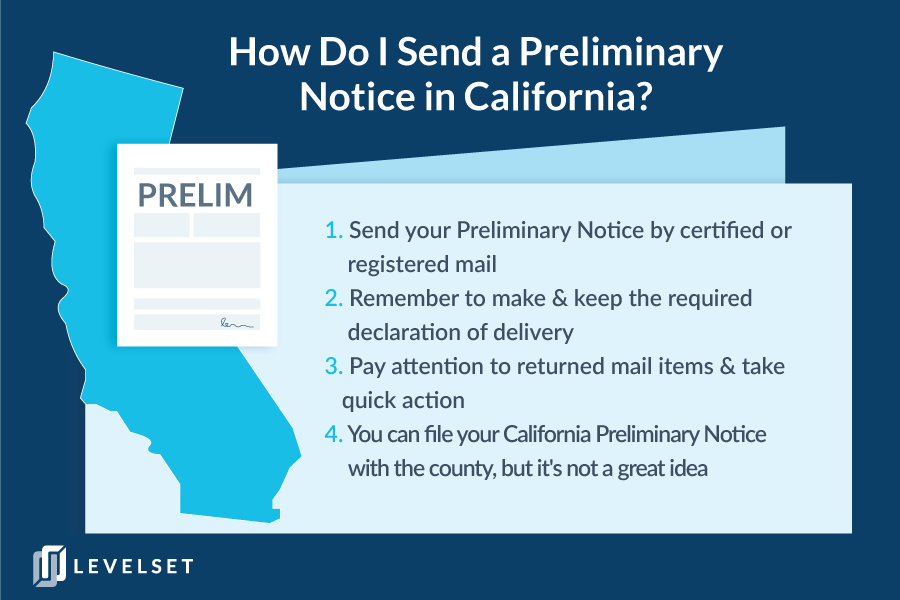
Send Your Preliminary Notice by Certified or Registered Mail
Send your notice by registered or certified mail, express mail, or overnight delivery by an express service carrier. No need to worry about a return receipt. The date that counts is the mail date, not the delivery date. Make sure you retain proof you mailed your notice. If the owner is out of state and the above methods do not work, you can send the owner’s notice via certified or registered mail to the construction lender or original contractor. The most cost-effective way is to send via United States Postal Service “certified mail.” This will give you a tracking number to confirm delivery and cost under $5.00.
One common question about sending preliminary notices is whether you can send these documents by hand, or personal delivery. We wrote about this question in detail in, “Can I deliver preliminary notices by hand?” In California, the law is not crystal clear on the matter. Personal delivery may be possible in California, but there are many reasons why it’s a bad idea. In short, it’s a much better idea to send the notice by mail.
We wrote a detailed article about the process of sending preliminary notices by certified mail, versus certified mail return receipt requested. You can read that here: How To Send A Notice To Owner – Certified Mail, or Certified Mail Return Receipt? In short, it’s appropriate, allowed, preferred, and ideal to send a preliminary notice with simple mail. The thing you need to pay attention to…is how to prove you sent it!
Make & Keep The Required Declaration of Delivery
Since the California preliminary notice requirement is met once the notice is properly sent, it is absolutely crucial that contractors and suppliers keep good records and proof that the notice was properly sent!
It can be confusing to figure out what you exactly you need to keep track of when sending California preliminary notices. As we explored in “What You Need To Track When Sending Preliminary Notices,” in California, you’ll want to have (or have access to) the following things as evidence for every preliminary notice sent:
- Scan of the actual mail piece sent
- An affidavit of mailing to document when it was mailed, how, and by who
- The certified or registered mail tracking number, and log of the status changes in the delivery
- A certificate of mailing from the post office
- Record of the research performed on the recipients to confirm the addressed information
Construction companies send hundreds of thousands of preliminary notices on their own every year. Nonetheless, they nearly always forget a very crucial requirement: Filling out and signing a Declaration of Delivery.
A California declaration of service or delivery is a very simple document. It’s simply a statement signed by the person who performed the service (i.e. the person who mailed the notice). It identifies themselves, when the notice was sent, that it was a preliminary notice sent, who it was sent to, and how it was sent.
Take Action on Returned Mail Items
Finally, even though the California preliminary notice requirement is considered met upon “sending,” that doesn’t let you off the hook to get the notice actually delivered.
The “effective upon sending” allowance is just a legal presumption. When the rubber meets the road, you need to get that preliminary notice actually delivered. If you can’t do that, then you must prove you tried really hard.
The truth is that sending preliminary notices in California is quite hard for all of the reasons above. On top of that, after you send out the mail piece, it might get returned!
Fortunately, there are steps you can take in the event of an undelivered notice. It’s important to do everything you can to protect your lien rights.
When your mail piece is “Rejected” or “Unclaimed,” your work is mostly done and you should be protected. However, it’s a best practice to put a copy in the mail with ordinary First Class postage.
It’s impossible to reject these types of mailings. Therefore, if the opposing party claims you failed to meet your obligation to deliver the preliminary notice, this is a good practice.
“Undeliverable” mail pieces are more complicated. You have some additional work to do figuring out why the mail piece failed, and taking corrective action.
Filing a California Preliminary Notice with the County
Finally, it is possible to file and record your preliminary notice with the county’s recorder office. The California laws do provide for this process, although it is not a requirement. Instead, prelims in California are supposed to benefit contractors and suppliers.
According to the California statutes, the county is supposed to notify all contractors and suppliers who file their preliminary notices whenever someone files a “Notice of Completion.” Since a “Notice of Completion” impacts the mechanic’s lien deadlines in California, it would be fantastic to get a notification whenever someone files one.
The problem is that the cost greatly exceeds the benefits, and the benefits are not very clear at all.
First, the cost is very high. Filing a preliminary notice in the county costs more than $60 in filing fees alone. For example, see Los Angeles County Recorder’s fees. This doesn’t even count the cost in time (or a courier) to to file it.
Second, the benefits are unclear. While the county is “supposed” to send filers copies of any Notices of Completion, the requirement is actually not a full-fledged “requirement,” and it’s unclear how organized the counties are at fulfilling this request.
In other words, whether you’ll ever get the Notice of Completion notification from the county recorder is a toss-up. Note also that this may be irrelevant and unnecessary anyway.
As explained by California construction attorney Garrett Murai, “Some…feel that [filing a California preliminary notice] is not important, since the project owner is already required to serve all persons from whom it has received a preliminary notice, with a notice of completion or notice of cessation within 10 days of recording such notices with the county recorder’s office.”
As such, while filing a preliminary notice in California is a nice concept, the execution itself is not nice at all. Filing a notice isn’t required. And in most circumstances, you shouldn’t even think about it. It’s not worth it.
Get Preliminary Notice Help With Levelset
California is the largest state in the country with a massive economy and a huge construction industry within the state and the surrounding region.
Thousands of California-based construction companies utilize Levelset to better manage their payment process, send documents (especially 20-day notices), secure their lien rights, and especially, to get paid.
We have some additional resources and information available for your below. And if you have more questions or even if you don’t know where to turn, we’re always here to help.
Need to send a 20-Day Notice?
We’re the 20-Day Notice experts. With us it’s fast, easy, and done right. And free.